

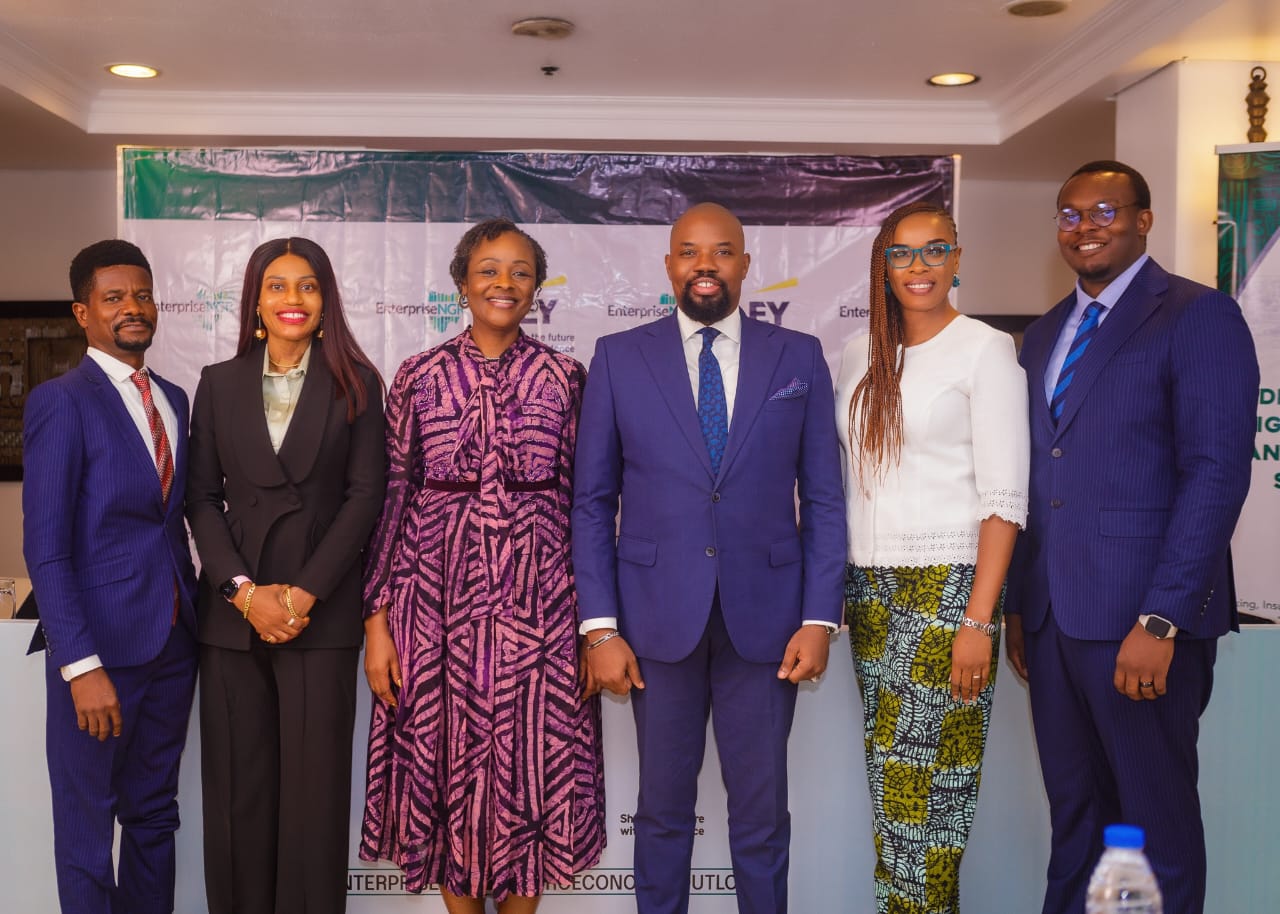
EnterpriseNGR, a member-led advocacy group representing Nigeria’s Financial and Professional Services (FPS) sector, on Thursday launched its 2026 Macroeconomic Outlook: A Financial and Professional Services Perspective and comprehensive assessment of Nigeria’s economic outlook.
The report, developed by EnterpriseNGR in collaboration with EY, examines the impact of recent structural reforms, including foreign exchange market liberalisation, fiscal recalibration, and financial sector strengthening, and outlines the implications for investors, policymakers, and the private sector.
It also positions Nigeria as an emerging opportunity in non-oil sectors, including financial services, energy, technology, and critical mineral resources, while cautioning that sustained policy discipline remains essential.
Speaking at the launch of the 2026 Macroeconomic Outlook in Lagos on Thursday, the Chief Executive Officer of EnterpriseNGR, Obi Ibekwe, noted that Nigeria is transitioning from a period of adjustment to one of stabilisation and renewed confidence.
She said, “Over the past few years, Nigeria’s economy has undergone a period of difficult but necessary adjustment. Reforms to the foreign exchange market, fiscal framework, and the financial system were not painless, but they were essential to correcting long-standing distortions.
“What the 2026 Macroeconomic Outlook makes clear is that Nigeria has reached a post-adjustment inflection point. The key indicators—inflation, foreign-exchange liquidity, external reserves, and investor sentiment—suggest that the foundations for macroeconomic stability have now been laid.
“The foundations for macroeconomic stability have been laid. The priority now is to convert reform gains into sustainable growth, investment, and improved welfare. This is the central message of this report.”
Also speaking, Associate Partner at EY-Parthenon, Olayinka Oyetunji, underscored the role of the financial and professional services sector in mobilising capital, supporting real-sector growth, and strengthening Nigeria’s investment case.
“I commend EnterpriseNGR for producing a report that is both timely and grounded in rigorous analysis. From a private-sector and investor perspective, what stands out clearly is that Nigeria is moving from adjustment toward stabilisation. Recent reforms in the foreign exchange market, fiscal management, and the financial system have materially improved transparency, liquidity, and confidence.
“One of the key messages in the 2026 Macroeconomic Outlook is that Nigeria’s opportunity set is widening beyond hydrocarbons. The growing role of services, financial intermediation, technology, and emerging opportunities in critical mineral resources—including gold and lithium—supports diversification and technology-orientated investment.
“This Outlook reinforces a balanced message: Nigeria’s fundamentals are improving, confidence is returning, and opportunities are expanding. The task now is to sustain reform credibility so that stabilisation evolves into durable, inclusive growth,” she said.
Presenting key findings from the report, Head of Research at EnterpriseNGR, Omotayo Muritala, highlighted easing inflation, improved foreign exchange liquidity, and strengthening external buffers as indicators of stabilisation.
He said: “The 2026 Macroeconomic Outlook examines Nigeria’s economy at a pivotal moment—moving from reform-driven adjustment toward stabilisation and renewed confidence.
“Looking ahead to 2026, our baseline projections point to moderate growth, easing inflation pressures, and improving investor sentiment—provided reform consistency is maintained.”
Speaking from a policy perspective, the Director of Policy and Public Affairs of EnterpriseNGR, Oyelami Adekola, emphasised the need for consistent reform implementation to sustain confidence and deepen market outcomes.
“The 2026 Macroeconomic Outlook points to the importance of aligning policy with emerging opportunities—from financial services and infrastructure to strategic and critical minerals, sustainable finance, and non-oil exports.
“Our role is to ensure that reforms translate into an environment where EnterpriseNGR members can mobilise capital, deepen markets, and support inclusive growth. The task ahead is clear: to protect reform credibility today so that confidence and investment can be sustained tomorrow,” he said.
EnterpriseNGR works with policymakers, regulators, and industry stakeholders to promote policy reforms, strengthen sector performance, and position Nigeria as a leading financial services hub in Africa.