

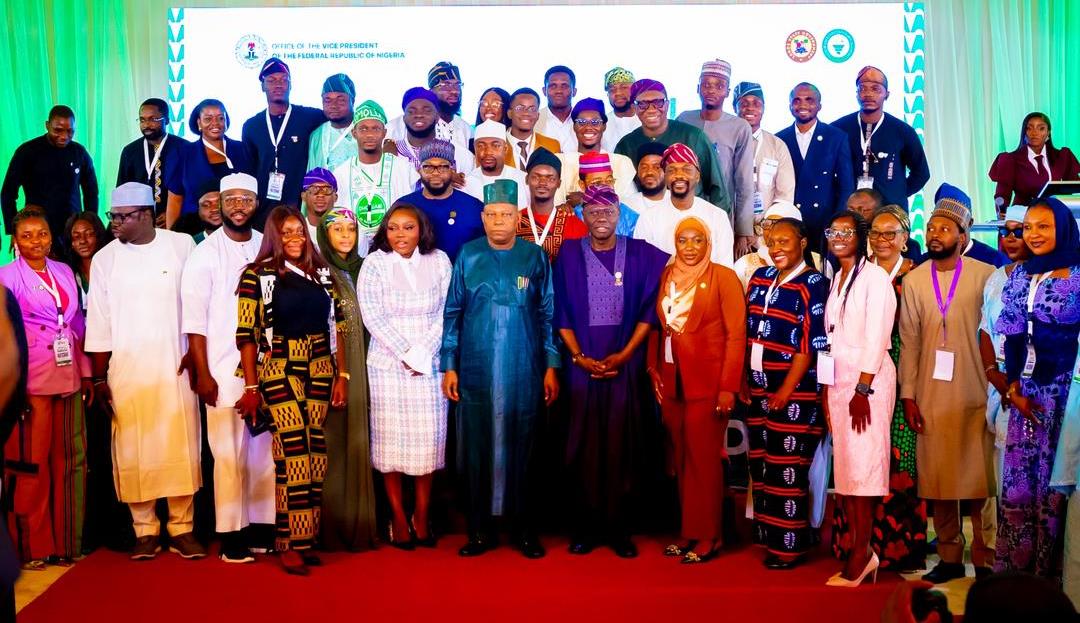
- ‘Young people must be intentionally guided through leadership’ — Shettima
- VP Office, Lateef Jakande Academy host National Dialogue on Leadership
What is the place of young people in leadership and development? A summit held at the State House Banquet Hall, the Presidential Villa, Abuja, on Monday, examined key contemporary factors influencing the youth’s attitude towards leadership roles.
Vice President Kashim Shettima posited that an institutionalised leadership approach should be cultivated by a nation seeking to convert the strength of its young population into national capacity.
Lagos State Governor Babajide Sanwo-Olu said whether or not young people mattered in leadership was not longer a subject of debate. He asked if the leaders had started to build systems, institutions and infrastructure required to channel the youth energy for national transformation.
These thoughts set the stage for discussion panels at the 2026 Abuja Dialogue organised by the Office of the Vice President and Lateef Jakande Leadership Academy (LJLA), an agency of Lagos State Government.
Minister of Youth Development, Comrade Ayodele Olawande, led various youth groups and young leaders across the country to the event with the theme: “Scaling Excellence: Youth Leadership as Strategic Infrastructure for National Transformation”.
Also in attendance were members of the Lagos State Executive Council, members of the body of Permanent Secretary in Lagos, led by the Head of Service, Mr. Bode Agoro, and Heads of various agencies, Heads of Federal Government’s parastatals, business leaders, development experts, members of academia and civil society.
 According to the Vice President, youth leadership should not be understood as a ceremonial handover. Shettima said young people should be raised in reliable pipeline of leadership through a structured process that would prepare, entrust, integrate and support them within the institutions shaping the nation’s future.
Without intentionally guiding young people through leadership, Shettima warned that the nation would be left to inherit fragility. He said it would be futile effort to prepare young people for yesterday and expect them to govern tomorrow. By building with intention, Shettima said the nation would secure continuity.
The Vice President said: “What is required is a forward-looking architecture of leadership development, one that prepares young people not only to function within existing systems, but also to improve them. That is how societies endure. Not by preserving institutions as relics, but by renewing them through capable hands and clear minds. The demands placed on leaders are changing with every shift in technology, finance, governance, and public expectations. We cannot prepare young Nigerians for yesterday and expect them to govern tomorrow.
“The government increasingly understands that national progress cannot be sustained without a reliable pipeline of leadership capacity across institutions. This is why the work of integrating young people into governance processes must be deliberate and consistent. It is a long-term investment. It demands cooperation between the classroom and the workplace, between public institutions and private enterprise, between mentorship and responsibility. It also demands standards.”
Shettima noted that leadership would lose its meaning when standards disappeared, pointing out that once expectations were lowered, institutions would erode from within.
The Vice President emphasised that today’s leaders must be intentional in equipping young people with progressive values, competencies, discipline, ethical clarity, intellectual rigour and emotional steadiness if the nation was serious about preparing the next generation.
“Leadership is not defined by age. It is defined by readiness to bear consequences, to choose the long view over easy applause, and to place the common good above private comfort. That is why this conversation matters. The future of Nigeria will not be decided by circumstance alone. It will be determined by the quality of the decisions we make and the consistency with which we implement them,” Shettima said.
Sanwo-Olu said Lagos State Government had consistently prioritised harnessing the energy and intellect of its over 15 million youth population, emphasising that young people were not merely a footnote in his administration’s development plans but a centerpiece of his Government’s policies and programmes.
The Governor said investment in human infrastructure remained the most crucial action for a nation’s long term success. He said budgeting for roads, bridges, and rail must be balanced by investment in the people that would sustain and govern them.
Sanwo-Olu said: “In Lagos, we invest billions in roads, bridges, rail systems, and waterways. We budget for power, for housing, for healthcare. No one questions the wisdom of these investments, because the returns are visible and the consequences of neglect are obvious.
“Without competent, ethical, and visionary leaders, every road we build will deteriorate, every institution we establish will atrophy, and every policy we design will fail in implementation. This is why Lagos treats leadership development not as social welfare, but as a strategic pillar of governance that is as critical as any physical infrastructure we have ever commissioned.”
What would happen if a nation fails to equip young people with requisite leadership skills? Sanwo-Olu said there would be a cycle of economic and social deficits that would be far more expensive to fix than they could prevent. This, he said, would bring about brain drain that could deplete the nation’s talent pool, while enriching other nations.
The Governor said the Lateef Jakande Leadership Academy was created to bridge the critical gaps in leadership ecosystem.
He said the Academy was not merely a fellowship programme, but also a talent incubator raising young leaders through structured programmes offering them real public sector immersion, cross-sector learning, policy exposure, mentorship from seasoned leaders, and the opportunity to execute projects that address real societal challenges.
LJLA Executive Secretary, Mrs Ayisat Agbaje-Okunade, explained that the dialogue was organised to discuss the ongoing challenges hindering the transition of leadership to the youth.
A nation striving for development and prosperity through progressive governance and robust institutions must be deliberate in identifying, nurturing its future leaders and positioning them effectively.
“It is believed leadership is not a moment. It is a process of formation that requires exposure, mentoring, structuring, accountability and practical experience. It requires young people to be integrated into the environments where decisions are made, where policy is shaped, where trade-offs are navigated, and where public service becomes real. Leadership is not learned only in classrooms; it is learned in systems,” Agbaje-Okunade said.